Authors
Arbatova Varvara Petrovna, Karpova Yesenia Alekseevna, Dagdelen Zeynap Rejepovna, Byugdanyuk Anna Vasilievna, Lyupp Sofya Romanovna
Peoples’ Friendship University of Russia (RUDN)
Moscow, Ordzhonikidze St. 3
Introduction
The formation of planetary systems is a key process in the evolution of the Universe
The theory explains the origin of the Solar System and exoplanets
Objective: To study the theoretical foundations of the formation of a planetary system from a gas and dust cloud
Origin of the Universe
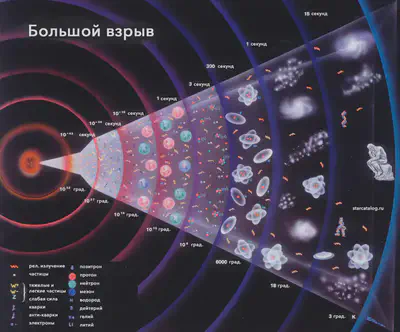
Expansion and cooling → particles → atoms → galaxies → stars
Schmidt’s Theory (1944)
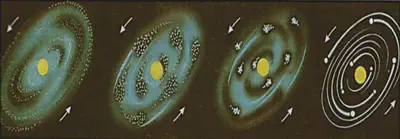
- A rotating gas and dust cloud contracts
- Rotation speed increases (law of conservation of angular momentum)
- The cloud flattens into a disk
- Rings form on the periphery → condense into planets
Laws of Motion
Kepler’s Third Law:
$$v \sim \frac{1}{\sqrt{r}}$$
Velocity decreases with distance from the center
Used to set initial velocities of particles
Gravitational Interaction
Potential Energy:
$$U_i = -\sum_{j \neq i} \frac{\gamma m_i m_j}{r_{ij}}$$
Gravity is a long-range force
Requires accounting for all particle pairs
Complexity O(N²) limits the model size
Repulsion and Friction Forces
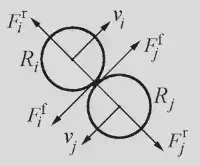
Upon approach $b < R_i + R_j$:
Repulsion: $F^r(b) = k\left(\left(\frac{a}{b}\right)^8 - 1\right)$
Friction: $F_f = \beta W_{\perp} F^r(b) \mathbf{n}$
Friction is perpendicular to the radius vector, directed against the motion
Particle Rotation
Moment of inertia: $I = \frac{2}{5} m R^2$
Equation of rotation: $I\varepsilon = R\sum\frac{b}{R_i+R_j}F^f$
Rotational energy: $E_{\text{rot}} = \frac{I\omega^2}{2}$
Particle Coalescence
Upon complete coalescence:
$m = m_i + m_j$
$R = \sqrt[3]{R_i^3 + R_j^3}$
$\mathbf{r} = \frac{m_i\mathbf{r}_i + m_j\mathbf{r}_j}{m_i + m_j}$
$\mathbf{v} = \frac{m_i\mathbf{v}_i + m_j\mathbf{v}_j}{m_i + m_j}$
Conserves the mass and momentum of the system
Key Mechanisms
| Mechanism | Role |
|---|---|
| Gravity | Attraction of particles, formation of clumps |
| Repulsion | Prevents particles from passing through each other |
| Friction | Energy dissipation, conversion to heat |
| Rotation | Accounting for angular velocity during collisions |
| Coalescence | Growth of planets from small particles |
Conclusion
The theoretical foundations of the formation of the Solar System have been reviewed:
- Cosmological prehistory (Big Bang, supernovae)
- Schmidt’s theory of protoplanetary disk formation
- Physical mechanisms: gravity, repulsion, friction, rotation, coalescence
The obtained foundations will be used for numerical modeling